Schema markup explained: what it is, why it matters, and how to get it right

In this post:

  • What schema markup actually is and how it helps search engines (and AI tools) understand your site
  • The specific schema types that matter most for small businesses – including restaurants
  • How to check your markup is working, and where to start if you haven’t got any yet

Schema markup is code you add to your website that helps search engines – and AI tools – understand exactly what your content means. One clear sentence. That’s really all it is. But the impact it can have on how your site shows up? That’s worth talking about.

You’ve probably seen search results that look a bit fancier than the rest – star ratings under a restaurant, opening hours for a local shop, a set of FAQs that expand right there on the page, or a restaurant menu listed directly in Google. That’s not magic. That’s structured data doing its thing.

It doesn’t change what visitors see on your site. But it can change how your site shows up in search results – and increasingly, how AI-powered search tools reference your content. That’s where it gets interesting.

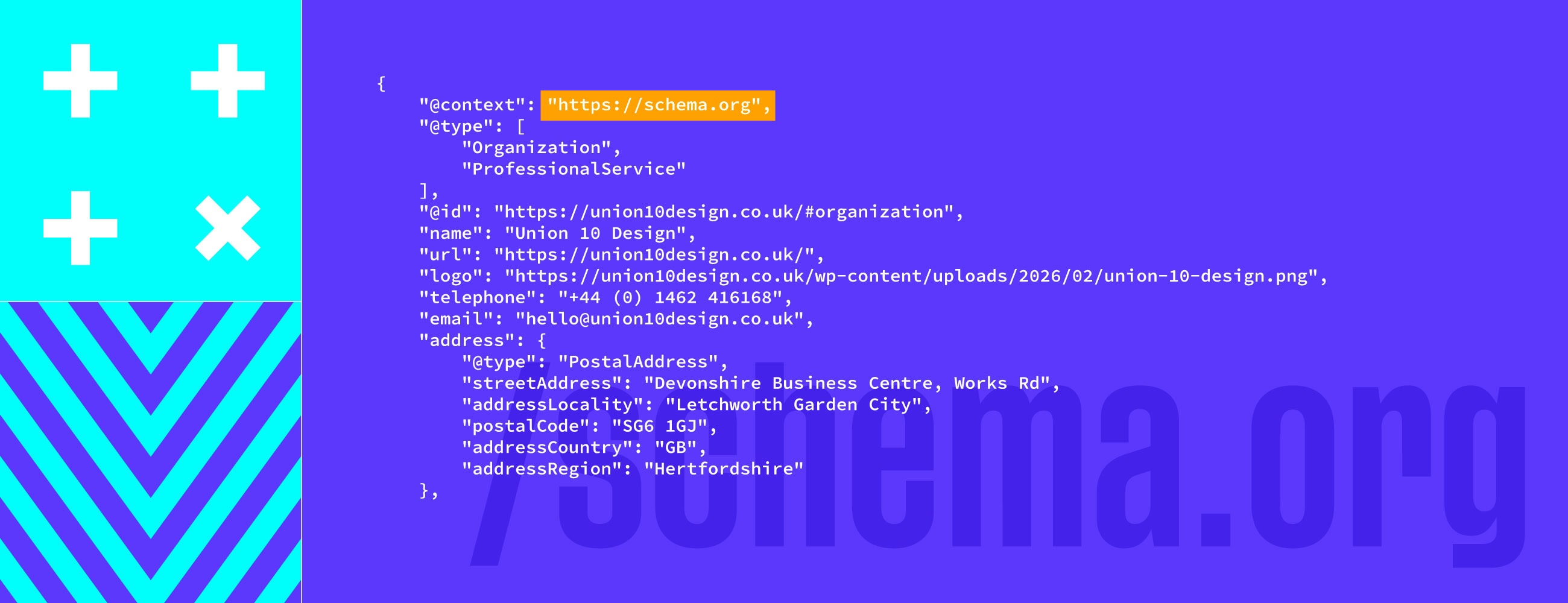
Branded graphic showing a JSON-LD schema markup code snippet for Union 10 Design, featuring Organisation and ProfessionalService types against a bold purple background.

How does schema markup work?

Schema markup uses a shared vocabulary from schema.org – a project backed by Google, Microsoft, Yahoo, and Yandex. You add a small block of structured data (usually in a format called JSON-LD) to your web pages, and search engines read it to understand the context of your content.

For example, without schema markup, Google sees your address as just text on a page. With LocalBusiness schema, it knows that text is your business address – along with your phone number, opening hours, and location. The result? Your listing in search can show up as a rich result – with extra details that make it stand out and give people the information they need before they even click through.

Why does schema markup matter for SEO?

Schema markup doesn’t directly boost your rankings – Google has been clear about that. But it does some seriously useful things that indirectly help your SEO:

Better visibility in search results

Rich results take up more space on the page and catch the eye. Think star ratings, FAQs, how-to steps, event dates, and menu items. Pages with rich results tend to get higher click-through rates because they look more trustworthy and informative.

Helps search engines understand your content

The clearer search engines are on what your page is about, the better they can match it to the right searches. Schema removes ambiguity and gives Google the context it needs to connect your content with the right people.

Keeps you competitive

Less than a third of websites use schema markup properly. That means getting it right gives you an edge over competitors who haven’t bothered. When two pages have similar content, the one with structured data is more likely to earn that rich result slot.

Schema markup and AI search in 2026

This is where things get really interesting right now. AI-powered search experiences – like Google’s AI Overviews, Bing Copilot, and other generative search tools – are changing how people find information. Instead of just showing a list of links, these tools pull together answers from multiple sources and present them directly.

Schema markup gives these AI systems a structured, reliable way to understand your content. When your site has clean structured data, AI search tools are much more likely to cite you. Here’s what that looks like in practice:

  • AI-generated answers. If your business details, services, and FAQs are clearly marked up, AI tools can pull that information directly when generating responses to relevant queries.
  • Voice search. Siri, Alexa, and Google Assistant all rely on structured data to answer spoken questions. If someone asks “what time does [your business] close?”, schema markup is what gives them the right answer.
  • Future-proofing. As AI search continues to evolve, structured data is becoming the common language between websites and search engines. Getting it right now means your site is ready for wherever search goes next.

The key things to have marked up for AI visibility: your business name, address, and phone number (NAP), opening hours, services offered, and FAQs. These are the details AI Overviews pull from most frequently.

Schema types every business should know about

There are hundreds of schema types, but you don’t need to worry about most of them. Here are the ones that matter most for small and medium-sized businesses:

LocalBusiness schema

This is the big one for any business with a physical location or service area. It tells search engines your business name, address, phone number, opening hours, and more. It’s essential for local SEO and helps you show up properly in Google Maps and local search results.

Service schema

If you offer specific services – like web design, branding, or SEO – Service schema lets you describe each one with details like the service area, price range, and a description of what’s included. It helps search engines connect your pages with the right service-related searches.

FAQ schema

If you’ve got a frequently asked questions section on your site, FAQPage schema can turn those questions into expandable results right in Google. This can massively increase the space your listing takes up on the results page, and it’s one of the schema types most frequently cited by AI Overviews – which makes it especially worth implementing in 2026.

HowTo schema

Perfect for step-by-step guides, tutorials, or any process-based content. HowTo schema can display your steps directly in search results, sometimes with images for each step. If your site includes guides or help content, this is a great way to stand out.

Menu schema

If you run a restaurant, café, or any food business, Menu schema lets you mark up your food and drink offerings so they can appear in search results. Combined with LocalBusiness schema, it gives potential customers everything they need to decide to visit. We’ve helped restaurants get great results from this alongside well-designed menu pages.

Other useful types

A few other schema types worth knowing about: Organisation (tells search engines the basics about your company), Article (for blog posts and news content), Product (essential for ecommerce sites), and Breadcrumb (helps search engines understand your site structure).
How to check your schema markup is working

Adding schema markup is only half the job – you need to test it too. Here are the tools we’d recommend:

Google Rich Results Test – This is Google’s own tool. Paste in a URL or a code snippet and it’ll tell you which rich results your page is eligible for. It’s the best way to check whether Google will actually do anything with your schema.

Schema Markup Validator – Built by the schema.org community (backed by Google, Microsoft, Yahoo, and Yandex), this checks your markup against the full schema.org vocabulary. It’s more thorough than the Rich Results Test for catching structural issues.

Google Search Console – Once your schema is live, the Enhancements section in Search Console shows you which pages have valid structured data and flags any errors Google has found while crawling your site.

Our recommendation? Use the Rich Results Test first to check eligibility, then the Schema Markup Validator to catch anything it misses. And keep an eye on Search Console for ongoing monitoring.

Getting started with schema markup

If you’re running a WordPress site, plugins like Yoast SEO and Rank Math include basic schema features. But for more specific types – Service schema, Menu schema, or custom FAQ schemas – you’ll often need someone to add the JSON-LD code manually to get it right. It’s also worth noting that plugin-generated schema can be generic; manually written markup is almost always more accurate and more likely to trigger rich results.

Start with the basics: LocalBusiness schema if you have a physical location or service area, Organisation schema for any company, and FAQ schema on any page with questions and answers. Build from there. Even a little bit of structured data is better than none.

Schema markup by sector

Different types of business have access to different schema types – and some sectors have far richer structured data options than others. We’ve put together dedicated guides for the sectors where schema makes the biggest difference:

Restaurants and hospitality – Menu schema, reservation links, cuisine type, and opening hours – food businesses have some of the most powerful schema options available. Covers the full Menu schema hierarchy and what it means for AI search visibility.

Events and venues – Event schema is one of the few types that unlocks a dedicated Google search experience – the Events carousel. Covers event subtypes, venue Knowledge Panels, recurring events, and the content rules Google enforces strictly.

Healthcare and medical practices – Healthcare websites face the strictest quality standards in search. Covers MedicalClinic, IndividualPhysician, MedicalWebPage, and how schema connects directly to E-E-A-T signals – plus what the current AI search landscape actually looks like for medical queries.

Ecommerce – Product schema puts your price, stock status, reviews, and shipping directly into Google search results. Covers the difference between Product snippets and Merchant listings, the November 2025 shipping and returns update, and platform-specific notes for Shopify and WooCommerce.

Startups and new businesses – Schema markup for a new business isn’t about rich results – it’s about introducing yourself to Google as a recognised entity from day one. Covers the five-stage priority sequence every startup should follow, the sameAs property, and honest expectations about timelines.

FAQs

FAQs

If you have a question, please use our short form here to send it over. We’re always happy to chat.

Yes – this is one of the biggest reasons to get schema right in 2026. AI search tools use structured data to understand and cite your content. FAQ schema in particular is frequently pulled into AI-generated answers. Clean, well-implemented schema gives AI tools a reliable way to reference your business.

Not necessarily. WordPress plugins like Yoast and Rank Math handle the basics without any coding. But for custom schema types – particularly Menu schema for restaurants or Service schema for service businesses – you’ll usually need a developer to implement it properly. We handle this as part of our SEO and web development work.

Use the Google Rich Results Test to check whether Google can read your schema, and keep an eye on the Enhancements section in Google Search Console for any errors once it’s live.

LocalBusiness schema is the starting point for almost any business with a physical location or service area. Pair it with FAQ schema on key pages, and you’ve got a solid foundation. Restaurants should also prioritise Menu schema – it’s one of the most impactful types available for food businesses.

Not directly – Google has been clear that structured data isn’t a ranking factor. But it can improve your click-through rate by making your listing more prominent in search results, and it helps search engines understand your content better. Both of those things indirectly support your SEO.

Need a hand?

We add schema markup as part of our SEO and web development work – making sure your site is properly set up for both traditional search and AI-powered search tools. If you’re not sure what structured data your site has (or is missing), we’re always happy to take a look and point you in the right direction.

Written by Jane Comar + Reviewed by James Hofton

Last updated: April 10, 2026

Get in touch


Talk to us about your next project. We’d love to hear from you.